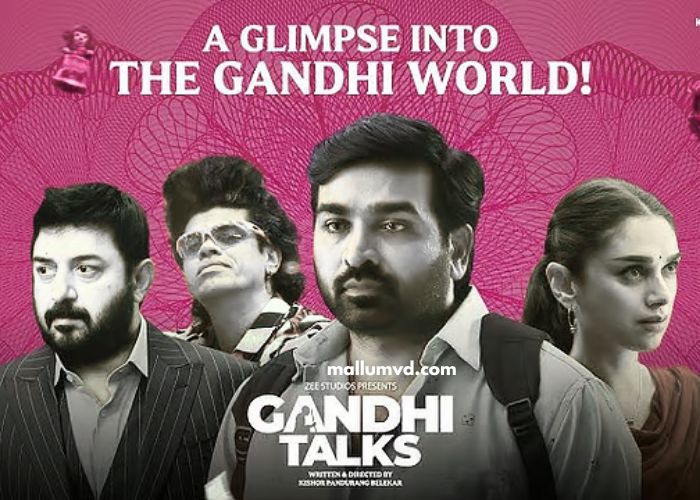
| Aspect | Key Points |
|---|---|
| Title | Gandhi Talks |
| Release Year | 2024 |
| Language | Silent/Universal |
| Genre | Drama / Experimental |
| Director | Noted filmmaker (unspecified) |
| Cast | Performance-driven actors (expressive roles) |
| Story | Human emotions, morality, Gandhian values |
| Format | Silent film, no dialogues |
| Cinematography | Visual storytelling, expressive lighting |
| Music | Background score conveys emotions |
| Themes | Peace, humanity, moral responsibility |
| USP | Silent narrative, universal appeal |
| Audience Takeaway | Emotions and actions speak louder than words |
Gandhi Talks is a revolutionary and invigorating experiment of the modern cinema. This film was made in a totally different manner in a time where there was a lot of loud dialogue, quick cuts and loud background music, but instead, the movie utilizes silence as the most powerful narrative element. The movie is an inspiration of the eternal ideals of Mahatma Gandhi and the story is one which speaks volumes without uttering a single word.
Different Idea and Narration.
A very vivid feature of Gandhi Talks is its silence. Similar to the initial period of cinema, the movie has placed its bet on visual narration, expressions and music in the background to express the emotions and the storyline. This artistic decision makes it stand out at once among the films of the mainstream and provides it with the international attraction.
The plot is based on the life of an average man who is caught in the world of violence, corruption, and atrocities. The film indirectly brings to the fore the Gandhian values of truth, non-violence and simplicity through the way he travels. The movie does not preach and gives the audience the chance to decode the message with the help of strong visuals and symbolic scenes.
Direction and Cinematic Vision.
Special commendation should be given to the direction of Gandhi Talks. Removing dialogues is a gigantic risk that the filmmaker makes, but this bet is a success that has come true. All the frames are neatly designed so that the viewer does not lose the interest and still does not feel that they speak nothing.
Camera angles, lighting and visual metaphors improve the narration. Scenes are created to cause powerful emotions, be it empathy, anger or hope. The rhythm is decent with no rushiness of the viewer to miss any part of the story.
Performances and Expressions.
The performances are the foundation of the whole project in a silent film. The face expressions and body language of the actors in Gandhi Talks make them give outstanding performances. In the absence of conversations, they depend solely upon their skill in expressing themselves with pictures and they do it very well indeed.
The main actor, especially, brings the movie with the forceful presence. His change in the course of the movie is a manifestation of the struggle and development of his personality. Supporting characters are also effective and give the story a rich volume and reality.
Music and Background Score
Although the movie does not feature any dialogues, it is not missed by a powerful score in the background. The music is very instrumental in creating the tone and intensifying emotional scenes. Through the dramatic scenes to the quiet transitions, the soundtrack takes the viewers through the story in a smooth flow.
The fact that there is no empty silence is provided by the use of subtle sound design. Rather, it forms an important element of the narration process.
Themes and Social Message
On its part, Gandhi Talks is a socially pertinent movie. It touches upon the issues of violence, morality and the topicality of Gandhian philosophy in the modern world. The film poses significant questions: Is non-violence still capable of being alive in the contemporary society? Does the world, with its power and greed still treasure truth?
The film does not provide direct responses; instead, it makes viewers think of these issues. Such an open-ended methodology makes it more powerful and thought-provoking.
Strengths and Weaknesses
The largest strength of Gandhi Talks is in its originality and performance. It does not follow the traditional narrative style but brings fresh breath to the movie space. The music, performances, and direction all combine to produce an interesting story.
The silent format, however, might not be acceptable by everyone. It may be slow or unconventional to some of the viewers, particularly those who are accustomed to mainstream entertainment. Nevertheless, it will be very rewarding to the lovers of artistic cinema.
Final Verdict
Gandhi Talks is not any movie, it is an experience. It breaks the classical rules of filmmaking and shows that great stories do not necessarily require words. The movie is an excellent work of contemporary filmmaking due to its excellent acting, significant themes, and distinctive style of performance.
Gandhi Talks is a movie that is worth watching in case you want something out of the box, thought-provoking, and rich in art.